Gas market overview Q3 2026
Europe Enters Winter Facing Elevated Risks
- The European gas market enters a tighter environment
- European Gas Storage: The refill gap widens
- Competition for LNG cargoes intensifies as Middle Eastern supply remains constrained
- Q4 Gas Market Outlook: Weather and LNG availability take centre stage
The European gas market enters a tighter environment
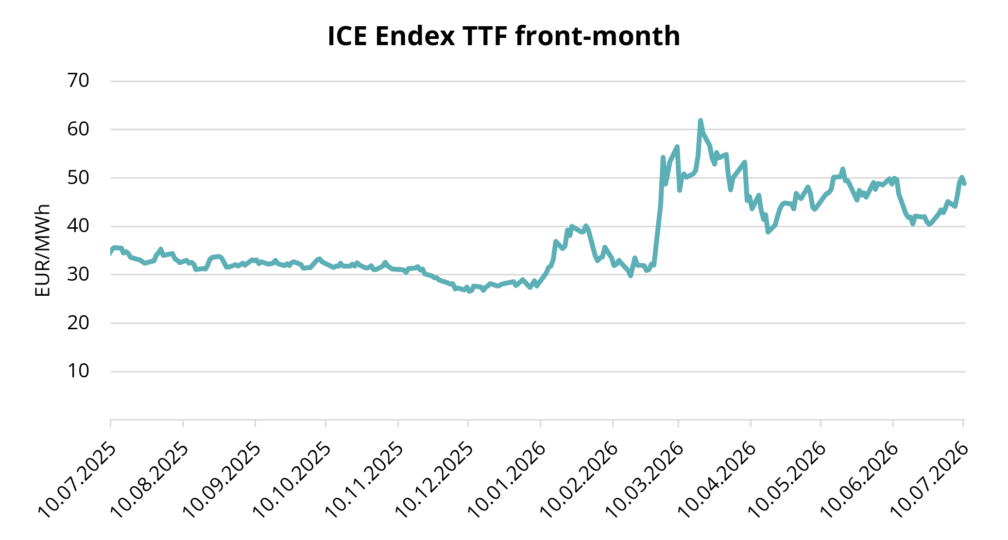
The third quarter marked a significant change in European gas market dynamics. Following the relatively stable conditions of Q2, when TTF front-month futures traded largely within the 40–50 EUR/MWh range, the market entered Q3 with the primary focus remaining on the ability to rebuild gas inventories before winter. Storage had reached only around 50% of capacity by the end of June, approximately 15 percentage points below the same period last year and the five-year average. As the quarter progressed, however, the gap widened further, despite inventories continuing to increase in absolute terms. This left Europe increasingly dependent on strong LNG imports during the final months of the injection season.

Figure 1. Gas prices, Refinitiv
TTF prices reflected the changing market balance. After closing June below 45 EUR/MWh, front-month prices moved higher during Q3, reaching approximately 84.50 EUR/MWh and trading in a strong bull trend almost the entire quarter. The increase was driven by a combination of the persistent disruption to LNG supplies from the Middle East, the increasingly challenging storage position and stronger competition for flexible LNG cargoes with Asia. By late September, TTF remained around 70 EUR/MWh, lower than the peaks see during the quarter, but significantly above the levels observed during Q2.
The main difference compared with Q2 was the persistence of the physical supply constraint. During the second quarter, geopolitical developments generated substantial volatility, but the ceasefire agreement and start of the Summer relieved the stress upon European gas market. During Q3, the effective closure of the Strait of Hormuz after the ceasefire agreement broke down before US and Iran significantly reduced LNG availability from Qatar and other Middle Eastern suppliers.
Despite the reduction in Middle Eastern LNG availability, Europe has avoided a physical supply shortage, but this has come at a higher cost. Alternative LNG supplies, particularly from the Atlantic Basin, together with continued pipeline imports, have allowed the market to maintain physical balance. However, the loss of Qatari volumes has increased competition for the remaining flexible cargoes and made the European market considerably more sensitive to developments in global LNG supply and demand. Throughout the Summer Europe was increasingly competing with Asian buyers for available spot LNG cargoes, with TTF maintaining a premium over competing destinations when required to attract supply.
The average price of the ICE Endex TTF front-month benchmark during Q2-26 was 63.69 EUR/MWh. Forward contracts for the nearest full month, November 2026, closed at 72.357 EUR/MWh on September 30th.

Figure 2. TTF forward prices, Refinitiv
The forward curve moved into backwardation for 2026 during March, meaning every month forward on the curve is cheaper than the previous, and this backwardation has remained still exists (see Fig. 2). There is sharp drop in the prices on the forward curve from Mar27 to Apr27 and then again rest of the CAL27 is in backwardation.
European Gas Storage: The refill gap widens
Europe entered the third quarter with storage inventories significantly below historical levels, creating a substantial requirement for additional injections before the heating season. Although inventories continued to increase throughout July, August and September, the pace of injections was insufficient to close the gap accumulated during the first half of the year. EU storage increased from approximately 50% at the beginning of July to around 71% by late September, but the difference versus the five-year average widened to approximately 15 percentage points.
The main reason was that Europe needed to inject gas at a significantly higher rate than in a normal year simply to catch up with historical levels. At the same time, the physical market became increasingly constrained as Middle Eastern LNG availability remained limited. Despite continued injections, the cumulative refill remained behind the pace required to fully close the deficit before winter.

Figure 3. Gas in European storage, 2020-2025, AGSI+
The economics of storage also remained challenging. The TTF forward curve continued to provide a limited incentive for market participants to buy gas during the summer and sell it during winter, with periods of backwardation persisting through much of the injection season. This is particularly important in a year when Europe needed to refill storage more aggressively than usual, given the low starting point. Without a sufficiently positive summer-winter spread, the cost of carrying gas through storage is not fully compensated by the forward market, increasing the importance of other mechanisms to support injections.
By late September, European inventories remained well below the five-year average, while the European Commission was warning that the combination of low storage and supply disruptions could create significant price pressure during the winter.
The key question heading into winter is whether the inventories accumulated before the start of the heating season will provide a sufficient buffer against stronger-than-expected demand or further supply disruptions. With storage entering winter from a weaker position and LNG availability more uncertain, weather will become an increasingly important determinant of market tightness.
It is important to note that Europe has ample LNG regasification capacity available, meaning that underground storage levels do not necessarily need to reach the historically targeted 90% level. Going forward, a storage level of around 70% could be sufficient, provided LNG availability remains strong, with no major disruptions in the global LNG market, and weather conditions remain close to historical averages. Therefore, the key question heading into winter is whether the inventories accumulated before the start of the heating season will provide a sufficient buffer against stronger-than-expected demand or further supply disruptions. With storage entering winter from a weaker position and LNG availability more uncertain, weather will become an increasingly important determinant of market tightness.
Competition for LNG cargoes intensifies as Middle Eastern supply remains constrained
The disruption to Middle Eastern LNG exports fundamentally changed the global gas balance during Q3. With Qatar representing a significant share of global LNG supply and shipments through the Strait of Hormuz severely restricted, Europe and Asia were forced to compete more actively for alternative cargoes. This increased the importance of Atlantic Basin LNG, particularly US volumes, as both regions sought to compensate for the loss of Middle Eastern supply.
European LNG imports were very weak in Q2 and this trend continued in the beginning of July. Given the overall storage situation in Europe it was not sustainable and Europe needed to attract more flexible LNG cargoes. It managed to do so, but the price required to attract flexible cargoes increased significantly, meaning it fueled the TTF price rise. TTF’s premium over JKM widened sufficiently to attract flexible cargoes towards Europe (see Fig.4).

Figure 4. European LNG send-out, 2024-2026, Refinitiv
The relationship between European and Asian prices therefore became increasingly important during the quarter. While European buyers needed LNG to compensate for the loss of Middle Eastern supply and to rebuild depleted storage, Asian buyers also faced reduced availability of Qatari LNG. When Asian prices moved above the European equivalent, flexible Atlantic cargoes became increasingly attractive for Asian destinations, increasing competition for European supply.
The market remained highly dependent on the behaviour of Asian demand. High prices have already encouraged demand-side responses in several Asian markets, while nuclear generation and alternative energy sources provide some flexibility in Japan and South Korea. However, a colder winter in North Asia could quickly increase LNG demand at precisely the time when Europe also needs to withdraw the storage heavily. Recent market assessments have therefore highlighted the possibility of LNG price increases if European and Asian demand strengthens simultaneously.
Q4 Gas Market Outlook: Weather and LNG availability take centre stage
Europe enters the final quarter of 2026 in a considerably more challenging position than at the beginning of the year. Storage inventories have increased substantially from the below-30% level recorded at the end of Q1, but the improvement has not been sufficient to close the gap with previous years. Instead, the deficit relative to both 2025 and the five-year average has widened during Q3. With the injection season effectively coming to an end, the market will increasingly shift from concerns about storage refilling towards the pace of winter withdrawals.
The main source of uncertainty will be winter weather. A normal or mild winter would allow the existing storage position and available LNG imports to provide sufficient flexibility, particularly if pipeline flows remain stable and additional Atlantic Basin LNG is available. A colder-than-normal winter, however, would increase withdrawal rates at a time when inventories are already below historical levels. The sensitivity of TTF prices to weather is therefore likely to be significantly higher than in a year with more comfortable storage levels.
The global LNG balance will be equally important. The continued disruption to Qatari LNG exports removes a significant source of supply from the global market, while the effective closure of the Strait of Hormuz continues to limit the ability of affected producers to return to normal export levels. Market does not expect quick solution to this problem and most likely the challenges with Hormuz will remain also in Q4. How and when the situation between the US and Iran is resolved will be a key determining factor for price action in the coming months.
At the same time, Europe will need to compete with Asia for available flexible LNG cargoes. If Asian demand remains moderate, Europe should be able to attract sufficient LNG at elevated but manageable prices. However, a combination of strong Asian demand, colder European weather or further supply disruptions could rapidly tighten the global LNG balance. Recent market developments already show Europe paying a premium when necessary to secure available cargoes.
Overall, the European gas market enters Q4 with less storage flexibility and a tighter global LNG market than initially expected. The central question for the winter will be whether reduced Middle Eastern LNG supply can be sufficiently compensated by Atlantic Basin production and whether European demand remains moderate enough to avoid rapid storage depletion. Consequently, TTF prices are likely to remain highly sensitive to weather forecasts, LNG flows and geopolitical developments affecting global LNG trade.
This market overview is for informational purposes only. We aim to compile the most relevant data from various sources in good faith but the analysis should not be treated as an advice or taken as the sole basis for any action.