Power market overview Q3 2026
Summer Lows Give Way to Rising Winter Risks
- Strong Local Supply but Higher Regional Prices
- Estonia and Latvia Drift Further Apart
- Q4 and Q1 Outlook: Higher Prices Expected Through Winter
Strong Local Supply but Higher Regional Prices
The third quarter started with the lowest prices of the year in Finland and Estonia. In July, Finland averaged 15.37 EUR/MWh and Estonia 43.93 EUR/MWh, supported by good Finnish nuclear availability and seasonally low demand. Latvia and Lithuania had their cheapest month of the quarter in July, but at a clearly higher level of around 75 EUR/MWh. Prices then rose through August and more sharply in September, when Latvia and Lithuania averaged around 108.5 EUR/MWh, Estonia 74.85 and Finland 56.98.
Over the quarter, Finland averaged 37.9 EUR/MWh, Estonia 59.3, Latvia 87.7 and Lithuania 88.0. Compared with Q3-2025, Finland and Estonia were slightly cheaper (by 2.5 and 5.8 EUR/MWh), while Latvia and Lithuania were around 18 EUR/MWh more expensive.

Figure 1 2024-2026 Month average electricity spot prices
The increase in Latvia and Lithuania was not caused by weaker local conditions. Wind speeds in the Baltics were close to or slightly above the long-term average, and new capacity continued to add supply. Lithuanian wind generation was considerably higher than a year earlier, and solar output in Latvia and Lithuania reached the highest levels so far, with Latvian summer solar generation roughly double last year’s.

Figure 2 Month average solar power generation in Latvia
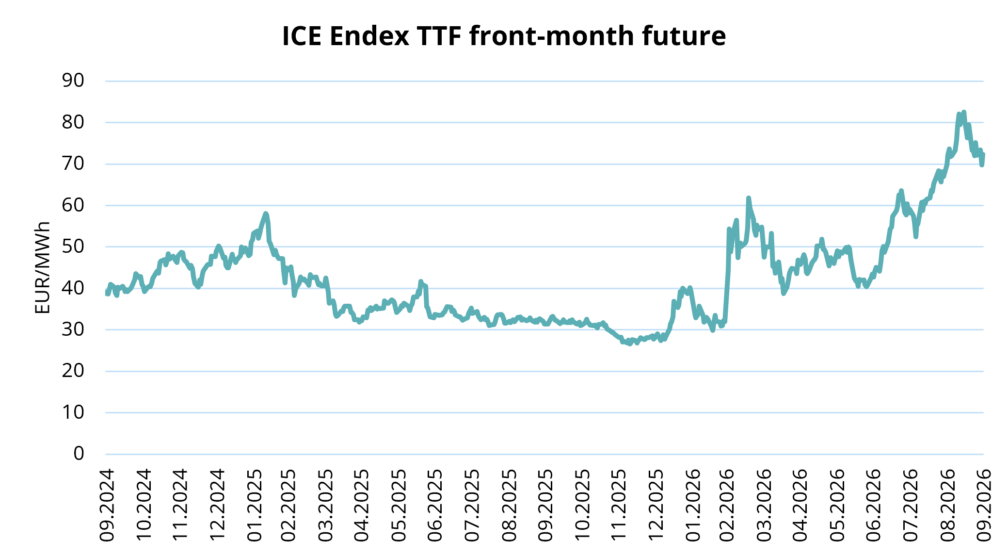
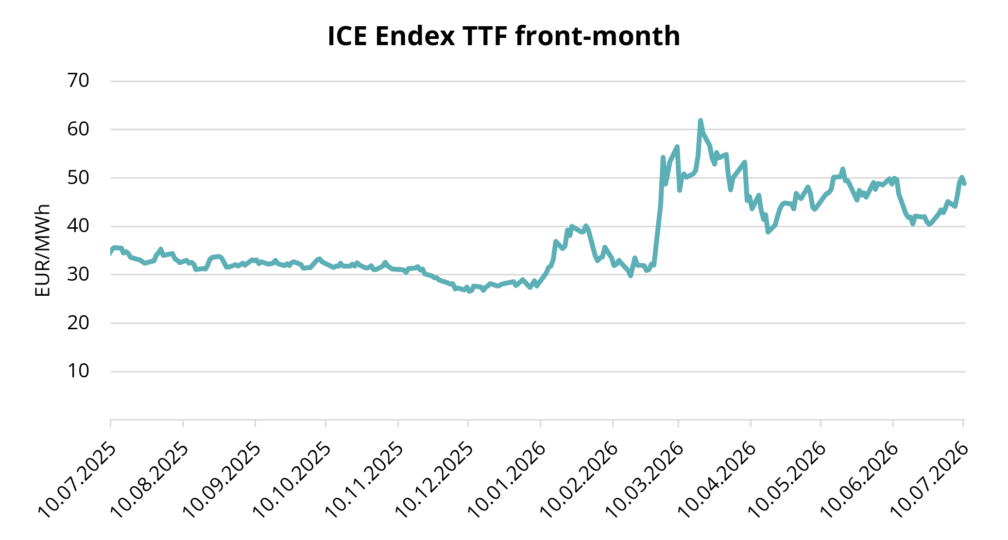
Instead, the pressure came from a higher price level in the wider region. The Nordic system price averaged 74.6 EUR/MWh in Q3 compared with 36.05 a year earlier, southern Sweden (SE4) 86.0 compared with 57.1, and Germany 125.7 compared with 82.8. Nordic hydro reservoir levels were well below normal in Q2, reducing the supply of low-cost hydropower. At the same time, gas prices were roughly twice as high as a year ago, which lifted power prices in Germany and other Continental markets.
Thanks to more wind and solar, Latvia and Lithuania imported less electricity than a year ago, and Lithuania often exported to Sweden during daytime hours. However, as Swedish prices were higher, even these surplus hours were priced clearly higher than last year. In hours when local wind and solar were not enough, the price was set by more expensive fossil fuel-based generation, either local or imported.
September added further pressure. Demand started to recover as the weather cooled, and several Finnish nuclear units, including Olkiluoto 3, entered their annual maintenance. In September, Finnish nuclear generation averaged around 2.4 GW, only slightly more than half of Finland’s installed nuclear capacity.

Figure 3 Month average nuclear power generation in Finland
Estonia and Latvia Drift Further Apart
The price difference between Estonia and Latvia continued to grow. Latvia was on average 28.4 EUR/MWh more expensive than Estonia in Q3, compared with 17.7 EUR/MWh in Q2 and only 5.2 EUR/MWh a year earlier. September’s difference of 33.7 EUR/MWh was the largest monthly figure of the last few years.

Figure 4 Month average price difference and available capacity between Latvia and Estonia
The main reason is the limited capacity of the Estonia-Latvia interconnection, as part of it is reserved for the Baltic balancing market. With power flowing mainly from Finland towards the south, the link is often fully used. Estonia then stays closer to the Finnish price, while Latvia and Lithuania follow the prices in southern Sweden and Continental Europe.
Although the available capacity was similar to last year, the price gap was much larger. This is because the difference between the markets on each side has grown. This summer, the price difference between southern Sweden and Finland was much larger than a year ago. Therefore, each hour when the link was fully used now caused a much larger price difference.
Q4 and Q1 Outlook: Higher Prices Expected Through Winter
The forward market expects clearly higher prices this winter. On 30 September, the day before Q4 started, Lithuanian Q4-2026 traded at around 144 EUR/MWh, and on 6 October Q1-2027 traded at around 146 EUR/MWh. For comparison, Lithuania averaged around 100 EUR/MWh in Q4-2025 and around 130 EUR/MWh in Q1-2026, which included a very cold January and February.
The main reasons are the same factors that lifted prices in Q3. European gas storage enters winter well below the five-year average and gas prices remain high, while the Nordic hydro balance is below normal. Demand will also rise seasonally as temperatures fall. On the positive side, Finnish nuclear plants are expected to return to full output in November, and strong Baltic wind capacity will help keep prices lower on windy days.
We expect Estonia to remain somewhat cheaper than Latvia and Lithuania. However, the difference is usually smaller in winter.
As always, weather will be the main swing factor. Cold and low-wind periods, such as in January and February this year when monthly prices exceeded 150 EUR/MWh across the Baltics, are the main upside risk. A mild and windy winter could bring prices below current forward levels. Developments in the gas market, including the US-Iran situation and its effect on LNG supply, remain the other key uncertainty.